
Hannah Arendt is very “Brat,” if I use a quintessential summer 2024 term to help age this post like milk, but I find it fitting after finishing The Human Condition, my last stop in this month of Arendt. With a basic understanding of her work, I now see why it’s not always easy to support her, either as an academic or as a fan. She is, in fact, arrogantly problematic. However, it’s the kind of confidence that can benefit anyone attempting something creative, or even humanity as a whole.
In his speech on Arendt, Richard J. Bernstein discusses how Arendt would have been terrified to know that people view her work as a practical guide. I think she’d be surprised by how much the mainstream media have taken her words literally, reducing her entire existence to a misunderstood phrase in her book, one that carries far more weight than is often perceived. Just as her readings of Marx and Plato were unconventional, I believe she wanted her readers to challenge her, argue with her, and draw their own conclusions—because for her, that is what thinking is all about: weaving the net over and over again.
I was introduced to Arendt quite early in my university years, but in the worst way possible. Naturally, it was through Eichmann in Jerusalem, and of course, it was the most clichéd interpretation of it, mixed with Philip Zimbardo’s Stanford prison experiment. For me, this month was very much a detox from the oversimplification of a collection of work that remains ever so relevant, and from the over-analyzed secondary readings of a text meant primarily to inspire further thought and continuous self-criticism from its readers. In short, I needed to rethink how I approach any text, in a very Arendtian way: misinterpreting the source material with arrogant confidence while humbly admitting the underlying motive, to derive new ideas that never cease to self-improve.
Must-read Trio to understand Hannah Arendt
If you want to get into Hannah Arendt after reading this blog, the first thing you need to do is ignore any book review or analysis of her work until you finish at least Eichmann in Jerusalem. At most, check the book introductions for a general idea—it will make sense later. There are three books you should read in sequence:
- The Origin of Totalitarianism
- Eichmann in Jerusalem: A Report on the Banality of Evil
- The Human Condition
Here’s my simple introduction to these three books and how I connected them to trace her line of thinking. I find it helpful to connect the dots between a writer’s work to see their growth and changes. If you enjoy analyzing pop singers’ discographies—deciphering lyrics, artwork, or the “shade” behind tracks—you may find this equally entertaining, if not more so, since writers are usually messier. I also suggest reading or listening to them in this order.
The Origin of Totalitarianism
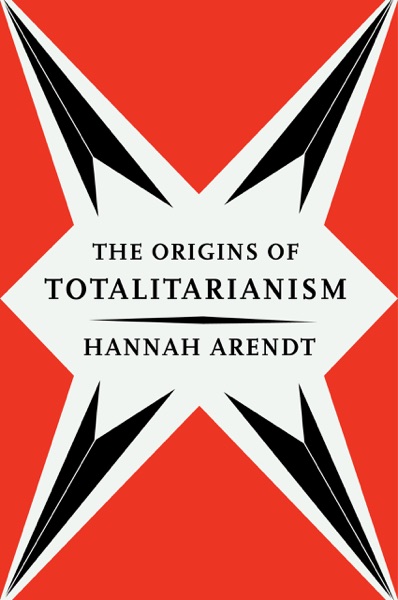
The Origins of Totalitarianism
Author: Hannah Arendt
Publisher: Harcourt
592 pages | 1951
I put The Origins first because it provides the necessary context to understand concepts that help make sense not only of antisemitism or Nazism but the macro-level causes of any radical movement in general. Even without dramatizing current world affairs to hype its importance, I think Origins remains an essential textbook on racism, imperialistic tendencies, and the atomization of individuals and its eventual consequences. Personally, I believe her analysis of “exceptional” individuals within the Jewish community before the 20th century is still very relevant in the context of mass migrations. It should help us understand and, to a limited extent, predict the attitudes of the intellectuals that will emerge from these communities and their impact on society.
Don’t be discouraged if you don’t find the first part, especially the initial chapters, very engaging. This is mostly due to how the book is organized. Arendt initially intended to write a book on imperialism but ended up adding more historical background on antisemitism in part one. As a result, you’ll notice a significant change in narrative style from part two onwards, where the book becomes more linear. Also, if you’re unfamiliar with some historical events she briefly mentions but doesn’t fully explain, don’t worry—she likely returns to them later. For instance, I was initially frustrated not knowing much about the Dreyfus affair, which she immediately analyzed after the first mention. But a few pages later, she laid out the details very clearly. Arendt seems to prefer setting up the structure first and then delving into it non-linearly, and you’ll get used to it by part two.
Nevertheless, this is not an easy read, nor was it meant to be. When asked not to include too many quotes from ancient Greek sources, as readers might not understand them, she famously replied: “Why? They should.” The book becomes more accessible once you grasp its overall structure, and you can fill in the details during a second reading. I strongly suggest checking out this YouTube channel to help understand the text and build the book’s structure (the background music is very loud in the first few videos, but it improves later).
At the end of the book, Origins poses some unanswered questions: What drives large populations to attempt to exterminate an entire people and culture in an organized manner? Who are the individuals who actively take on the role of committing such evil? And by now, you should be prepared to read her most controversial book.
Eichmann in Jerusalem

Eichmann in Jerusalem: A Report on the Banality of Evil
Author: Hannah Arendt
Publisher: Penguin Classics
312 pages | 1963
Eichmann in Jerusalem attempts to examine one of the most infamous war criminals from WWII, the individual embodiment of evil that Arendt was so curious about in Origins. The title gives away the rather disappointing answer to her curiosity: there’s nothing extraordinary about this war criminal who transported millions to their deaths; in fact, he’s just a balding, bureaucratic cliché of a person. The book uses Eichmann’s trials as a device to examine the mass deportation of Jewish people by the Nazis, and the complicity of various European governments. Finally, Arendt arrives at a conclusion she couldn’t fully articulate in Origins about the nature of evil: it’s the thoughtlessness, the absence of rational thinking, that turns people into monsters and permits them to commit evil deeds.
This book has garnered both the most praise and the most criticism, and the term “banality of evil” has become a common phrase since its publication. Because of its subject matter and, I believe, mainly due to the tone in which the trials are narrated, the book was met with significant backlash when it was published. However, since the 2000s, it seems to have received more attention, with much more positive reception. Still, most of the reviews I’ve encountered rarely go beyond the now-clichéd concept of the banality of evil and Arendt’s supposedly unfair treatment of Jewish collaboration with the Nazis. There is much more to this book than what it has been reduced to. This is why I advised earlier not to read reviews before tackling the book yourself.
To get the most out of this book, I believe you need to read The Origins of Totalitarianism first. It provides the necessary context to understand the broader machinery behind Eichmann, which he largely blames for his actions. It’s also fascinating to sense Arendt’s disappointment upon encountering Eichmann. She likely expected him to be far more intelligent, or at least a maniacal radical figure, rather than the mundane bureaucrat he turned out to be. This expectation led to a more calm and nuanced interpretation of history, one that can be difficult to digest due to Arendt’s seemingly indifferent tone.
The book raises important and unfortunately still relevant questions: What should be said about the aftermath of the trial and the trauma of WWII? How should Jewish people and humanity at large recover, remember, and establish a new way of doing things to prevent such monstrosity from happening again? What are the long-term implications of such events on society and humanity? The next book should help tremendously when contemplating these questions.
The Human Condition
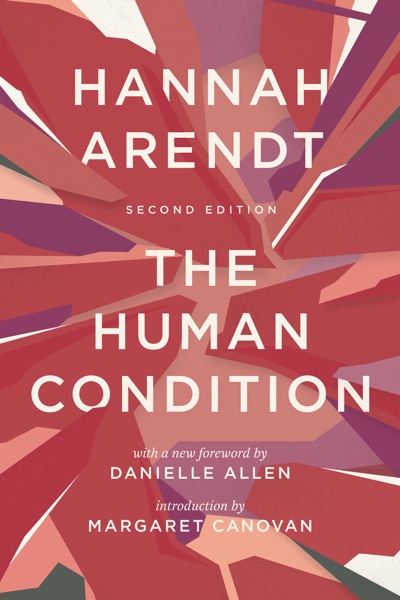
The Human Condition
Author: Hannah Arendt
Publisher: University of Chicago Press
380 pages | 1958
This one is just fun. The Human Condition, written before the Eichmann trials, is more theoretical in nature. It categorizes human activities into three types and examines how they have evolved with technological advancement and the emergence of mass society, particularly the blurring of the private and public realms. I see the book as an indirect but somewhat optimistic answer to her previous questions—almost an antidote to totalitarianism, although Arendt would likely disagree. I suggest treating it like a self-help book and ignoring the parts that heavily rely on ancient Greek anecdotes. You can start directly from Part V, which focuses on Action, and then circle back to Part I if you want some very original takes on Marxist philosophy. Also, you can confidently skip the untranslated Greek, Latin, and German quotes—don’t worry, she revisits and explains them many, MANY times.
I find this book fascinating. Initially, I was confused because there are so many unusual takes on Marx, Plato, and Aristotle—almost as if the book were set in a parallel universe where common words like “work” and “action” mean something entirely different. But despite this, I was able to finish my first listen and immediately started a second round, this time with the paperback in hand. I now use this book almost as a dictionary, checking interesting anecdotes Arendt uses to elaborate on her somewhat wacky ideas. This 300-page book is packed with concepts that deserve their own blog post. For that reason, I will soon write a more in-depth analysis of this book. I can honestly say I’m excited to finish it for the second time.
And…Now What?
In all honesty, this post is meant to encourage me to write more about Arendt and drive me to reread her work more often. In the near future, I plan to focus on reading and writing about Action, the core concept of The Human Condition. Thinking about this has made me want to revisit The Republic and use it as an opportunity to practice my French reading skill. This endeavor will obviously take some time, since my french is…not quite there yet. But with translation apps in hand (doesn’t sound quite as nice as saying dictionaries in hand) I believe it will be worth every minute.
 Yes the color name.